
- 15Feb
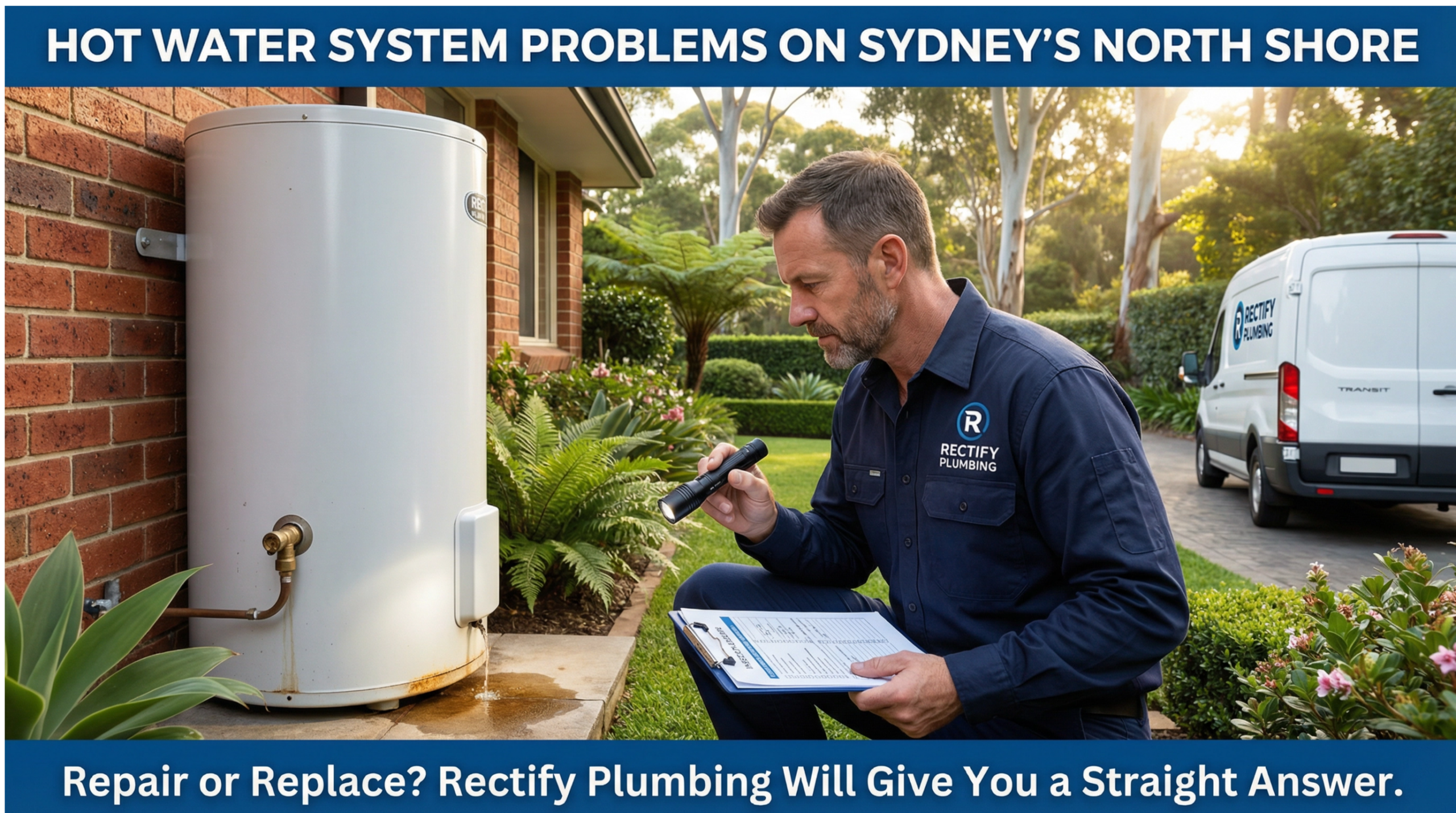
Hot Water System Problems on Sydney's North Shore: Repair or Replace?
There is nothing quite like stepping into a cold shower on a winter morning in Pymble to make you want to sort your hot water system out immediately. We hear it all the time — the unit has been playing up for a while, but the family just kept dealing with it, and then one morning it stopped working altogether.
Hot water system calls are one of the most consistent parts of our work across the North Shore and Upper North Shore — Pymble, Mount Colah, Turramurra, Ryde, Killara and everywhere in between. And the question we get asked most often is a straightforward one: is it worth repairing this thing, or should we just replace it?
That answer depends on a few factors — the age of the unit, what’s actually wrong with it, and what type of system you have. This article will walk you through all of it, including what the different hot water system types are actually like to live with, what commonly goes wrong, and what you can expect when you call us out.
Why Hot Water Systems Fail — and Why North Shore Homes See It More Than You’d Think
These Units Work Around the Clock
Most people don’t think about their hot water system until it stops working. That’s understandable — it sits out in the garage or on the side of the house and just quietly does its job. But unlike most appliances, your hot water system is running 24 hours a day, seven days a week, heating and maintaining a tank of water at a constant temperature regardless of whether anyone’s using it.
That constant cycle of heating and cooling puts stress on components over time. Elements wear out. Thermostats fail. Anodes — the sacrificial rod inside the tank that protects it from corrosion — get depleted and stop doing their job. Most of these issues are fixable if they’re caught early enough. The problem is that most homeowners don’t know to look for them.
Hard Water and Sediment Buildup
The North Shore sits on relatively hard water compared to some other parts of Sydney. Over time, mineral sediment settles at the bottom of your hot water tank — you might have heard a rumbling or popping sound coming from your unit at some point. That’s sediment sitting on the heating element and interfering with how efficiently it can heat the water.
Left long enough, sediment buildup reduces the system’s efficiency, increases energy bills, and shortens the lifespan of the unit significantly. It’s one of the most common things we find in older hot water systems on the North Shore, and it’s largely preventable with regular servicing — which most people skip entirely.
Age Is the Biggest Factor of All
A gas storage hot water system has an average lifespan of about 10 to 12 years. Electric storage systems last roughly 8 to 12 years. Continuous flow (instantaneous) units tend to last longer — sometimes up to 20 years with good maintenance. Heat pump systems sit somewhere in the middle.
If your system is approaching or past those ages, it’s worth factoring that into the repair-or-replace decision. Spending several hundred dollars repairing a 13-year-old electric storage system might not be the best use of money if the unit is likely to need another repair in 12 months.
Quick tip: Write the installation date on a piece of tape and stick it to the unit right now if you don’t know how old it is. You can usually find the age from the serial number — call us and we can help you decode it.
Signs Your Hot Water System Needs Attention
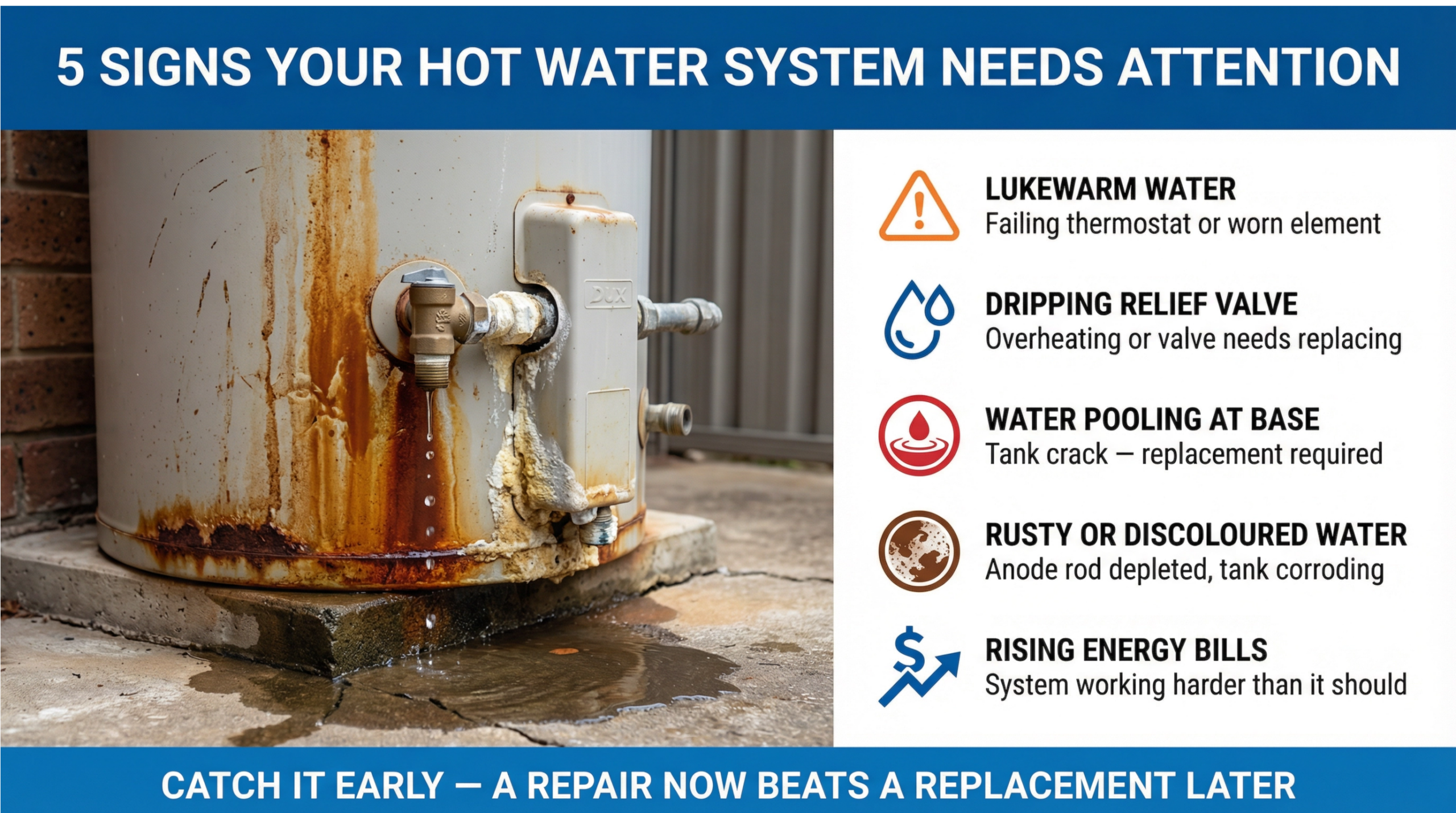
Some of these are obvious. Some aren’t. Here’s what to look for before the system fails completely:
You’re Getting Lukewarm Water Instead of Hot
If the water gets warm but never really hot, or it’s hot for two minutes and then drops off, the most likely culprits are a failing thermostat, a worn-out heating element, or a tank that’s too small for your household’s demand. All of these are diagnosable and usually repairable.
The Pressure Relief Valve Is Dripping
Every hot water system has a temperature and pressure relief (TPR) valve on the side — it’s a safety device that releases pressure if the system overheats. If that valve is dripping water constantly, it’s either working overtime because the thermostat is set too high, or it’s worn out and needs replacing. Either way, don’t ignore it. A TPR valve that fails completely is a serious safety issue.
Water Around the Base of the Unit
A small amount of condensation around the base is sometimes normal. A puddle, or water that keeps reappearing after you dry it up, is not. It usually means the tank itself has developed a crack or a pinhole leak — and once that happens, the tank needs to be replaced. There’s no patch for a leaking hot water tank.
Discoloured or Rusty Water
If you’re getting brown or rust-coloured water from your hot tap, the anode rod inside your tank has likely been depleted and the tank is starting to corrode from the inside. This is a sign the system is near the end of its life. Some
leaking tap and water quality issues can also point back to hot water system problems — it’s worth getting both checked at the same time.Your Energy Bills Have Crept Up
A hot water system that’s working harder than it should to heat the same amount of water will show up on your electricity or gas bill over time. If you haven’t changed your habits but your bills have gone up, the hot water system is worth looking at — especially if it’s more than eight years old.
We had a call from a homeowner in Mount Colah whose electric hot water system had been making a loud rumbling noise for about six months. She’d been told by someone it was ‘just normal’. When we arrived, the heating element was almost completely caked in mineral scale and the anode rod had been depleted for years. The tank itself was still in good condition, so we replaced the element and the anode and the system ran quietly and efficiently from that point on. If she’d left it another year, the tank itself would have started corroding and we’d have been looking at a full replacement. A repair at the right time saved her a significant amount of money.
Repair or Replace — How We Actually Make That Call
This is the honest version of how we work through it when we arrive at your property. There’s no fixed rule, but there are a few clear indicators on each side.
Repair Makes Sense When…
The system is under 8 to 10 years old and the fault is a single component — a thermostat, an element, a valve, an anode rod. These are relatively straightforward repairs and the cost is usually well worth it given the remaining life of the unit. We carry common replacement parts on the van, so in many cases it’s done on the same visit.
Even an older system can be worth repairing if it’s been well maintained and the fault is genuinely minor. We’ll tell you honestly what we find.
Replacement Makes More Sense When…
The tank itself is leaking — full stop. There’s no repair for a cracked tank. The system is over 10 to 12 years old and we’re finding multiple issues, or the repair cost is getting close to half the price of a new unit. The system has had repeated repairs in the past two or three years. Or there’s been a complete loss of water to the unit due to a
burst or failed pipe that’s also caused damage to the system itself.If replacement is the right call, we’ll explain exactly why, give you a fixed price, and in most cases we can do it the same day. We stock and install gas, electric and heat pump systems.
And Sometimes It’s a Conversation About Upgrading
A lot of North Shore homeowners we work with are still running older electric storage systems that are costing them more to run than they need to. Heat pump systems in particular have improved dramatically in the last few years — they use roughly a third of the electricity of a standard electric storage system, and the government rebates available in NSW can significantly offset the upfront cost.
It’s not a conversation we push on people — but if the question comes up, we’re happy to walk you through what makes sense for your property and your energy usage.
Gas vs Electric vs Heat Pump — Which One Suits a North Shore Home?
Gas Storage and Continuous Flow
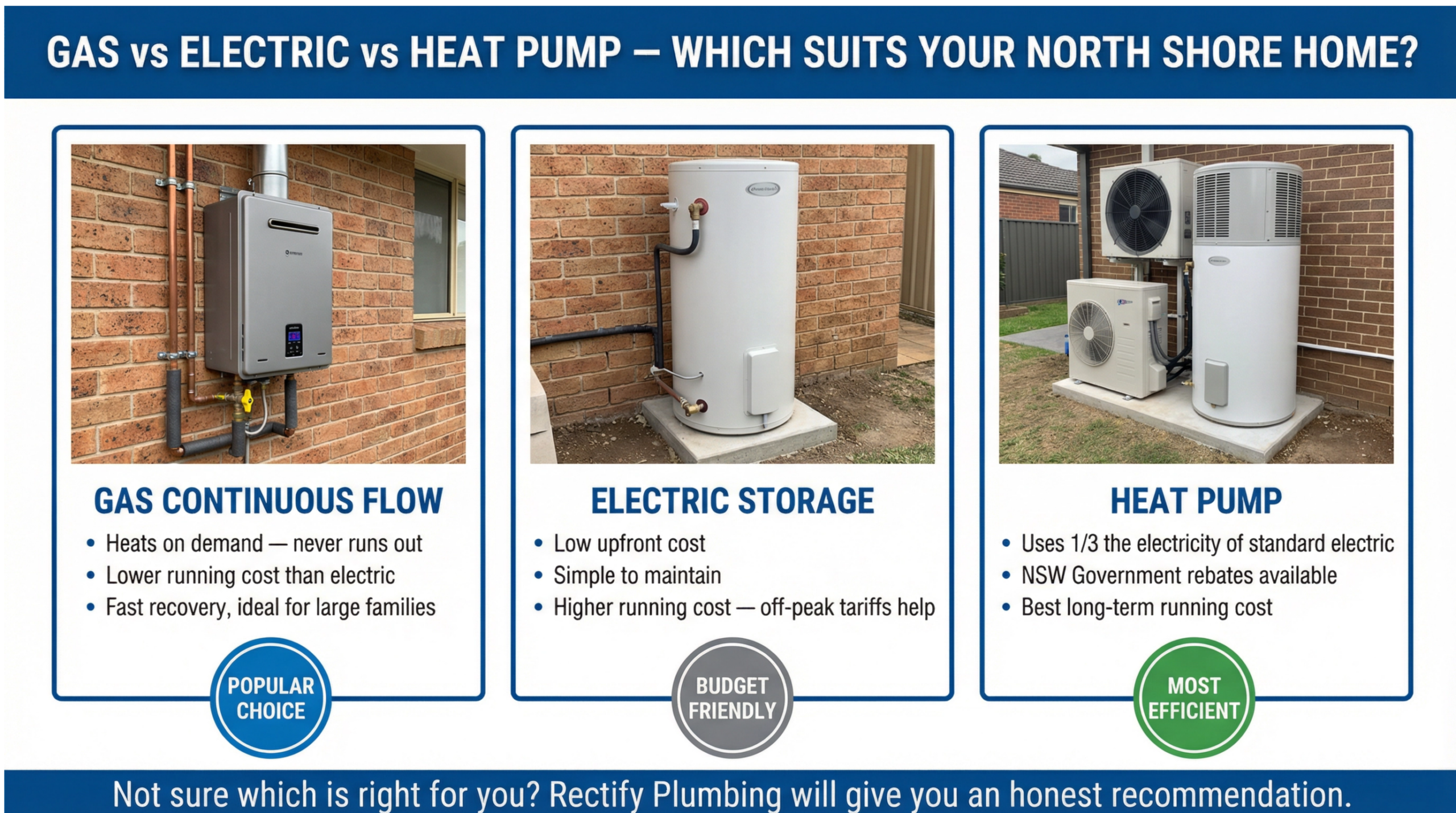
Gas systems heat water quickly, recover fast, and generally have lower running costs than standard electric storage — though that gap has narrowed in recent years as electricity tariffs have shifted. Continuous flow gas (also called instantaneous) is popular in North Shore homes because it only heats water on demand, which means you’re not paying to keep a tank warm around the clock. It also means you never run out of hot water mid-shower.
The catch is that gas continuous flow systems require a large gas pipe to deliver enough flow rate, so if your home doesn’t already have the right gas supply, there can be additional installation cost involved.
Electric Storage
Electric storage systems are straightforward, have low upfront cost, and are easy to maintain. The downside is running cost — they’re more expensive to operate than gas or heat pump systems, particularly in a larger household where demand is high. Off-peak tariffs can reduce this, but it requires your hot water system to be set up to use off-peak electricity, which not all of them are.
If you’ve got an older electric storage system that’s still working fine and you’re not ready to switch, a simple service — checking the element and replacing the anode — can extend its life considerably. Our
hot water repair and installation service covers all electric system types.Heat Pump Systems
Heat pumps are the most energy-efficient option available — they move heat from the surrounding air rather than generating it, which is why they use so much less electricity. They’re also eligible for significant government rebates under the NSW Energy Savings Scheme, which can bring the installed cost down meaningfully.
The main considerations are that they need adequate space and airflow around them to work efficiently, and they do make some noise during operation — less than an air conditioner, but more than a standard storage system. For most North Shore properties with reasonable outdoor space, they’re a very strong choice.
Quick tip: If you’re replacing an old electric storage system, it’s worth asking us about heat pump rebates before you decide. The rebate can sometimes cover a third or more of the replacement cost.
What to Expect When You Call Rectify Plumbing for a Hot Water Problem
Same-Day Service Where Possible
Hot water isn’t an optional luxury — especially in winter, and especially in a family home. We do everything we can to turn around hot water jobs on the same day, including emergency callouts when the system has completely failed overnight. When you call, we’ll ask a few questions to understand what we’re dealing with, let you know roughly how long we’ll be, and turn up with the parts most likely to be needed based on what you’ve described.
A Diagnosis Before a Quote
We don’t give you a price over the phone and then change it when we arrive. We come out, look at the system, tell you what’s wrong, and give you a fixed price to repair or replace before any work starts. If you’d rather get a second opinion before committing, that’s completely fine — we won’t pressure you.
We Cover the Whole North Shore
Our team regularly services Pymble, Mount Colah, Turramurra, Ryde, Killara, St Ives, Thornleigh and the surrounding North Shore suburbs. If you’re not sure whether we cover your area, just call — the answer is almost certainly yes. Take a look at our full
plumbing services and get in touch anytime.North Shore Homeowners — We’ll Give You a Straight Answer
Hot water problems have a way of feeling more complicated than they need to be. Different system types, repair versus replace decisions, rebates, running costs — it can be a lot to work through when you just want hot water.
Our approach is simple: we come out, we look at what you’ve got, and we tell you honestly what we’d recommend and why. No upselling you a new system if a repair will sort it. No patching something that’s genuinely past its useful life just to send you a cheaper invoice today.
Rectify Plumbing services hot water systems across Pymble, Mount Colah, Turramurra, Ryde, Killara, St Ives, Thornleigh and the wider North Shore. We’re available 24 hours a day for emergency hot water failures and aim for same-day service on all hot water jobs. Get in touch and we’ll get you sorted.
Request a Quote or Make an Enquiry -> rectifyplumbing.com.au
How long should I expect a hot water system to last?
Gas storage systems typically last 10 to 12 years. Electric storage systems are similar — somewhere between 8 and 12 years depending on maintenance. Continuous flow gas units often last longer, sometimes 15 to 20 years. Heat pumps are relatively newer technology but are generally rated for 10 or more years. The single biggest factor in longevity is whether the anode rod has been replaced every 5 years or so — most systems that fail early have had a depleted anode that nobody replaced.
My hot water has stopped working but it happened overnight — can I get someone out before work?
Yes. Early morning callouts are something we handle regularly — people wake up to cold showers and need to sort it before the day starts. Call us, tell us what’s happening and where you are, and we’ll let you know honestly how quickly we can be there. We cover Pymble, Mount Colah, Ryde, Turramurra and the surrounding North Shore suburbs for morning callouts.
Is it worth servicing a hot water system, or do you just replace them when they stop working?
It’s absolutely worth servicing — most people just never do it because nothing is visibly wrong. Checking and replacing the anode rod every 5 years or so can easily double the life of a storage system. Flushing sediment from the base of the tank improves efficiency and reduces noise. A preventative maintenance visit once every few years is a very small cost compared to an unplanned replacement.
Recent Articles
 Gas Plumbing in Sydney: What Only a Licensed Gas Fitter Can Do — and Why It MattersFebruary 28, 2026Gas plumbing is one of those areas ...
 Bathroom Renovation Plumbing in Berowra and Pennant Hills: What You Need to Plan Before You StartFebruary 20, 2026Most bathroom renovations start the ...
 Hot Water System Problems on Sydney’s North Shore: Repair or Replace?February 15, 2026There is nothing quite like stepping ...
 Emergency Plumber Epping: What to Do When a Plumbing Crisis Hits at the Worst TimeFebruary 12, 2026It’s always 11pm. Or Sunday ...
Contact Us
Rectify Plumbing offers comprehensive solutions for all of your residential and commercial plumbing needs across Sydney. Contact us today for a fast quote!
Get startedRelated Articles

Hot Water Repairs in Epping & Ryde: How To Tell If Your System Needs Fixing
The 3 Most Common Hot Water Problems in Epping & Ryde
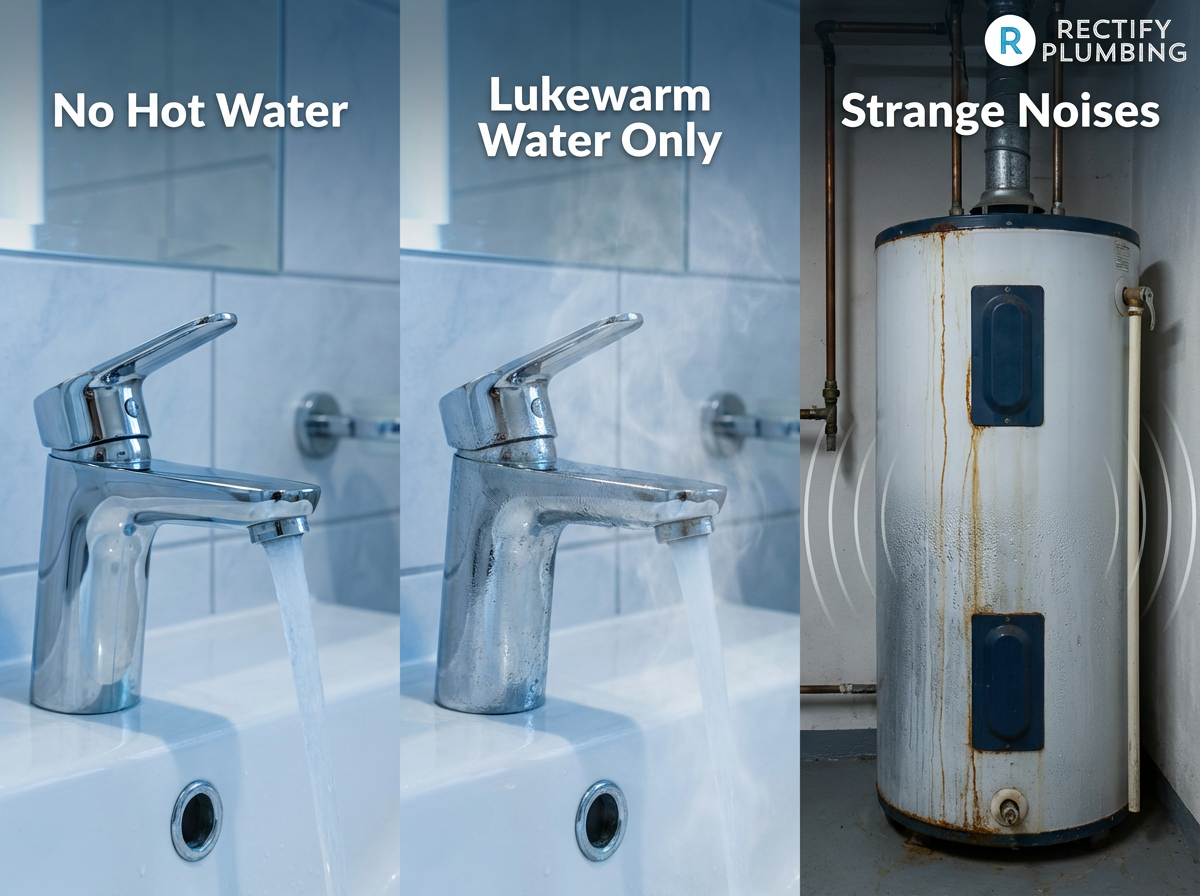 Before you call anyone, it helps to understand what is most likely going wrong:
- No hot water at all: This usually means the system has failed completely. For gas systems — which are the most common in Epping and Ryde — the pilot light may have gone out, or the gas supply could be interrupted. For electric systems, the element or thermostat has likely failed.
- Lukewarm water only: If you are getting some warm water but not enough, the thermostat is probably set too low or has malfunctioned. In electric systems, one of the heating elements may have failed while the other still works partially.
- Strange noises from the unit: Rumbling, popping, or banging sounds coming from your hot water system usually mean sediment has built up at the bottom of the tank. Over time this sediment hardens and causes the tank to overheat in spots, producing the noise. Left unattended, it can lead to a full system failure.
Gas vs Electric: What Do Most Epping & Ryde Homes Have?
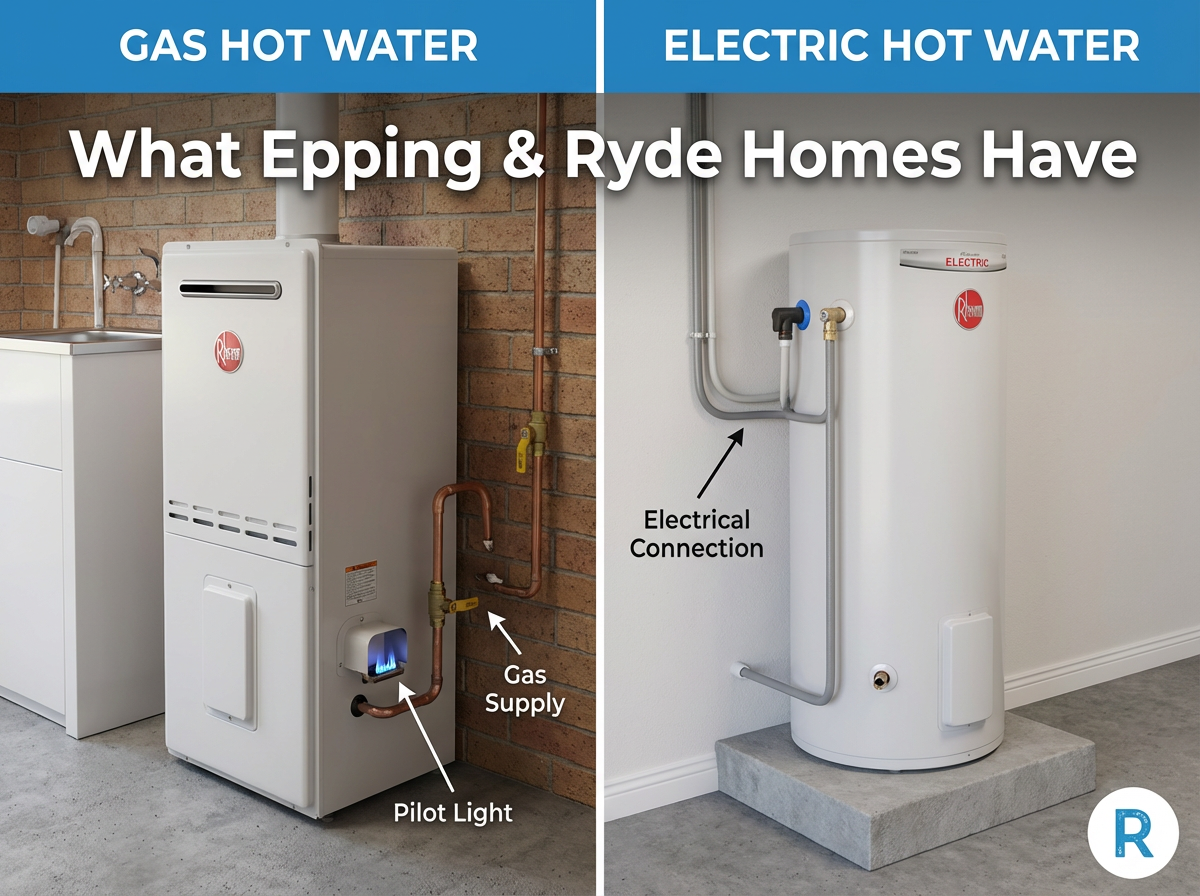 Most homes in Epping and Ryde run gas hot water systems. Gas units heat water faster, run more cheaply day to day, and are the standard choice for homes in these suburbs. However, some older properties — particularly in parts of Ryde — have electric systems, especially if they were converted at some point or if gas was not available on the street.
Knowing which type you have matters because the diagnosis and repair process is different. A gas system issue might be as simple as relighting the pilot light. An electric system failure usually means replacing an element or thermostat — but these are quick fixes for a licensed plumber.
Most homes in Epping and Ryde run gas hot water systems. Gas units heat water faster, run more cheaply day to day, and are the standard choice for homes in these suburbs. However, some older properties — particularly in parts of Ryde — have electric systems, especially if they were converted at some point or if gas was not available on the street.
Knowing which type you have matters because the diagnosis and repair process is different. A gas system issue might be as simple as relighting the pilot light. An electric system failure usually means replacing an element or thermostat — but these are quick fixes for a licensed plumber.
Signs Your Hot Water System Needs Repair RIGHT NOW
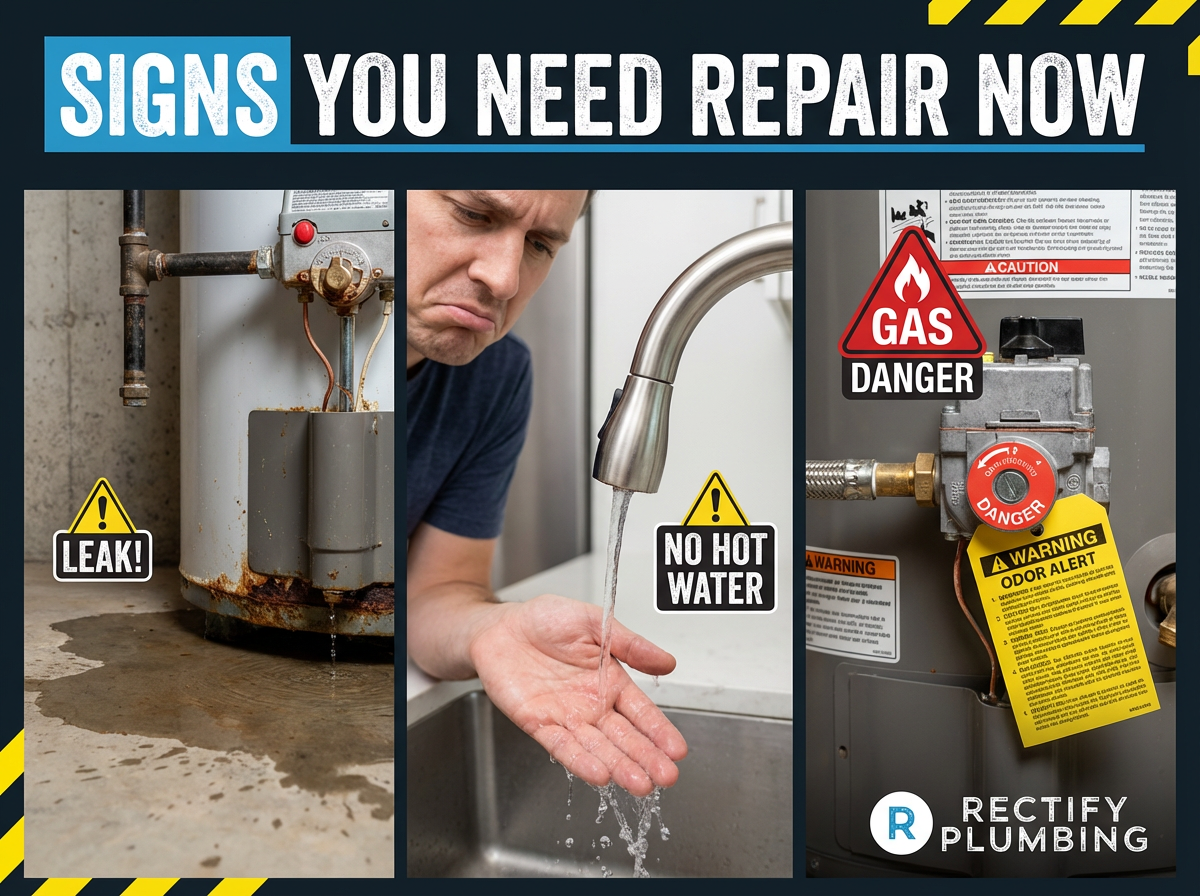 Do not wait on these. A failing hot water system will not fix itself:
- Completely cold water: The system has stopped working. Call a plumber today — do not wait.
- Water pooling around the base of the unit: This means the tank is leaking. If left, it can cause water damage to the floor or surrounding area.
- Constant running or cycling: If the system seems to be working overtime and still not producing enough hot water, something is wrong internally.
- Gas smell near the unit: If you can smell gas around your hot water system, turn it off immediately and call a gas plumber. Do not attempt to fix it yourself.
DIY Checks You Can Safely Do Yourself
 There are a few things you can check before calling out a plumber — but be careful and know your limits:
- Gas systems — check the pilot light: If the pilot light is out, you can relight it by following the instructions printed on the front of your unit. If it will not stay lit, there is a deeper problem.
- Check the thermostat setting: The thermostat on most units is on the front panel. If it is set below 60°C, turn it up. The recommended setting is 60°C for most households.
- Listen for unusual sounds: If you hear loud banging or rumbling, the unit likely needs a service to flush out sediment.
Repair vs Replace: How To Decide
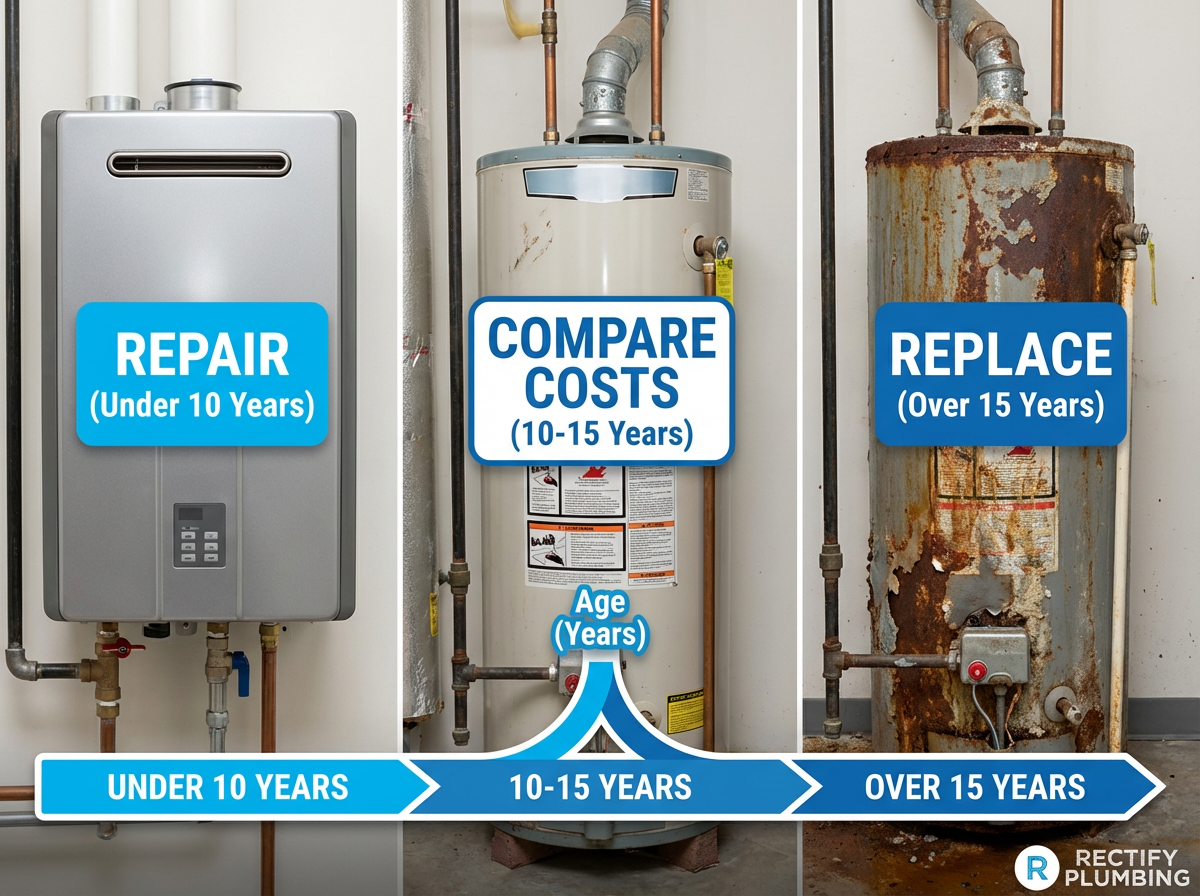 This is the question most homeowners ask when their hot water fails. Here is a simple guide:
- If the system is under 10 years old: A repair is almost always the right call. Parts are available, the unit still has life in it, and repair costs are a fraction of replacement.
- If the system is 10–15 years old and has had multiple repairs: It is worth comparing the cost of another repair against a new installation. At this point, a new system often works out cheaper in the long run.
- If the system is over 15 years old: Most gas hot water systems have a lifespan of 10–15 years. If yours is older than that and failing, replacement is the better investment. You will also benefit from a newer, more energy-efficient unit.
Why Same-Day Hot Water Repair Matters
Nobody wants to go without hot water. No showers, no washing up, no laundry — it affects everything in the household. That is why hot water repair in Epping and Ryde needs to happen fast. Rectify Plumbing offers same-day service for hot water repairs across both suburbs. Whether it is a gas system relight, a thermostat replacement, or a full unit swap, we carry the parts and can have your hot water back on the same day in most cases.